
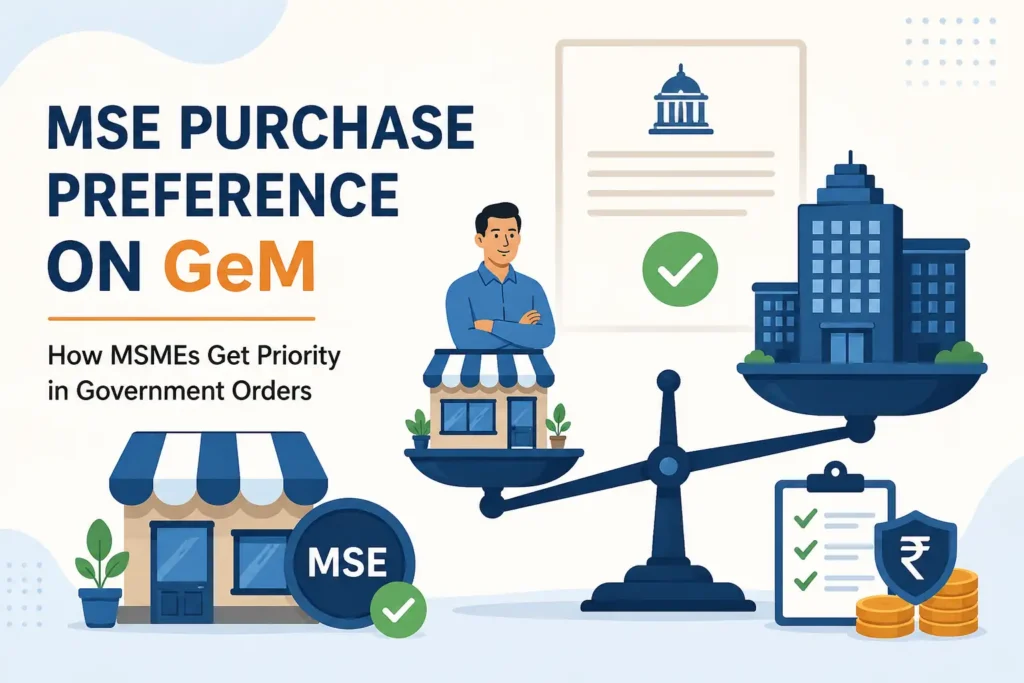
The MSE Purchase Preference on GeM is a government procurement policy that gives Micro and Small Enterprises a real pricing advantage when bidding against larger companies, allowing an MSE quoting within 15 percent of the lowest bid to match that price and still win a share of the order. This policy exists because Central Government ministries, departments, and public sector undertakings are required to source at least 25 percent of their annual procurement from Micro and Small Enterprises, with additional sub-reservations for enterprises owned by SC/ST and women entrepreneurs. On GeM, this translates into an active feature that can be switched on or off for a bid, and understanding exactly how it works is often the difference between an MSE seller losing an order to a bigger competitor and winning a fair share of it. This post explains where the policy comes from, how the price matching mechanism actually works, and what sellers need to do to benefit from it.
What Is MSE?
MSE stands for Micro and Small Enterprise, a classification defined under the Micro, Small and Medium Enterprises Development Act, 2006. The classification is based on two factors, how much a business has invested in plant, machinery, or equipment, and its annual turnover.
A Micro Enterprise is a business with investment up to 1 crore rupees and turnover up to 5 crore rupees. A Small Enterprise is a business with investment up to 10 crore rupees and turnover up to 50 crore rupees. Both fall under the MSE category, while Medium Enterprises, which have higher investment and turnover thresholds, are treated as a separate category under MSME and do not qualify for the purchase preference discussed in this post.
This distinction matters more than most sellers realize. Many businesses assume that because they are registered under MSME, they automatically get every benefit meant for smaller enterprises. In reality, several government procurement policies, including the purchase preference on GeM, are written specifically for Micro and Small Enterprises, not the full MSME spectrum. If your business has grown into the Medium category, you retain your MSME registration benefits generally, but you lose access to MSE specific advantages like the price matching preference covered later in this post.
Your MSE classification is verified through your Udyam Registration Certificate, which reflects your current investment and turnover figures. This is also why keeping your Udyam details updated matters, since a business that has grown but not updated its Udyam classification can end up misrepresenting its actual category on GeM, which creates complications during bidding or assessment rather than benefits.
Where This Policy Comes From
The MSE Purchase Preference is not something GeM invented on its own. It is rooted in the Public Procurement Policy for Micro and Small Enterprises, introduced under Section 11 of the MSMED Act, 2006. This policy applies across all central government procurement, and GeM simply implements it in a digital, bid-level format rather than leaving it to manual interpretation by individual buyer departments.
The intent behind the policy is straightforward. Small businesses often cannot compete purely on price against larger manufacturers or traders who benefit from scale, so the government built in a mechanism that lets small enterprises stay competitive without needing to undercut everyone else on cost alone.
Who Qualifies as an MSE for This Preference
To be treated as an MSE under this policy, your business needs to fall within the Micro or Small category as defined by investment in plant and machinery or equipment, and annual turnover. Medium enterprises do not qualify for this specific preference, even though they fall under the broader MSME umbrella.
Qualifying is tied directly to holding a valid Udyam Registration Certificate. If you are unclear on how Udyam registration connects to your GeM profile, it helps to first understand how GeM registration differs from Udyam MSME registration, since these are two separate registrations that need to work together correctly for your MSE status to reflect accurately on the portal.
What the Policy Actually Guarantees
1. A mandatory procurement quota Government buyers are required to source at least 25 percent of their annual procurement value from Micro and Small Enterprises. Within that quota, a portion is further reserved specifically for enterprises owned by Scheduled Caste and Scheduled Tribe entrepreneurs, and a separate portion for enterprises owned by women entrepreneurs.
2. Categories reserved exclusively for MSEs A defined list of items is reserved entirely for MSE sellers, meaning larger companies cannot even participate in procurement for those specific categories. This removes the competition question entirely for products that fall under this reserved list.
3. Relaxed entry conditions MSEs benefit from relaxations that larger sellers do not get, including exemption from tender fees and, in most cases, exemption from Earnest Money Deposit. If you are unfamiliar with how EMD normally works for sellers who are not covered under this exemption, our detailed breakdown of EMD on the GeM portal explains the standard process this preference helps you skip.
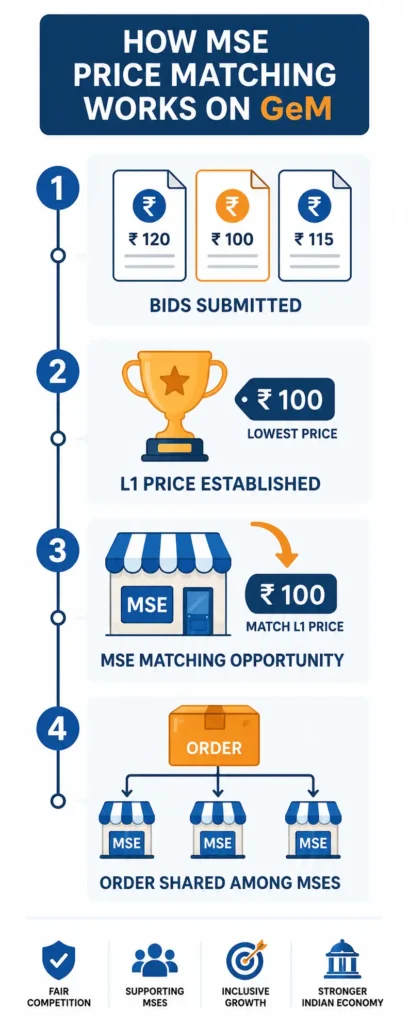
4. The price matching advantage This is the mechanism most sellers actually care about. If the lowest bid, commonly called L1, comes from a non-MSE seller, MSEs whose bids fall within 15 percent of that L1 price get the opportunity to match it and win a portion of the order instead of losing the bid entirely.
How Price Matching Actually Works on a Live Bid
Understanding this mechanism in practice matters more than knowing the policy exists on paper. Here is what typically happens.
1. Bids are submitted as usual All eligible sellers, MSE and non-MSE, submit their price bids for the tender through the normal bidding process. If you want a full breakdown of how different bid formats work on the portal, our guide on types of bid on GeM covers this in detail.
2. The L1 price is established Once bidding closes, the lowest quoted price across all participants becomes the L1 benchmark for that tender.
3. Eligible MSEs get a matching opportunity If the L1 bid came from a non-MSE seller, any MSE whose bid falls within 15 percent above that L1 price is given a chance to revise their quote down to match L1.
4. The order is shared among qualifying MSEs Rather than the entire order going to a single seller, up to a defined number of eligible MSEs who match the L1 price can share the contract, with a minimum portion of the total quantity reserved for MSE participation.
This means an MSE does not always need to be the absolute cheapest bidder to win business. Being reasonably close to the lowest price is often enough, as long as you are willing to match it when given the opportunity.
Making Sure the Preference Actually Applies to Your Bids
The MSE Purchase Preference has to be enabled by the buyer at the bid level, and your seller profile needs to correctly reflect your MSE status for the system to recognize you as eligible. A few practical steps matter here.
- Keep your Udyam Registration Certificate current and correctly linked to your GeM seller profile
- Before bidding, check whether the specific tender has MSE purchase preference enabled, since not every bid carries this feature
- Make sure your product or service category matches what your Udyam registration actually covers, since a mismatch here can affect how your eligibility is evaluated
- If your business has recently changed structure, ownership, or category, keep your profile updated so your MSE status does not fall out of sync with your actual documentation
Getting your foundational documentation and category mapping right during GeM registration is what makes this preference usable in the first place, since a profile with outdated or mismatched Udyam details can end up missing out on preference eligibility even when the business genuinely qualifies. Similarly, if your category requires vendor assessment before you can list certain products, getting that vendor assessment sorted correctly ensures nothing blocks you from actually bidding once you identify a tender where the MSE preference applies.
Common Mistakes MSE Sellers Make
A pattern we see often is sellers who technically qualify as an MSE but never actually benefit from the preference because their Udyam details on GeM are outdated, or their product category does not match what their registration covers. Another common mistake is assuming every single tender automatically includes MSE preference, when in reality it depends on whether the specific buyer has enabled it for that bid. Sellers who check this upfront, rather than assuming it applies universally, avoid wasting time bidding on tenders where the advantage simply does not exist.
Conclusion
The MSE Purchase Preference is one of the more meaningful advantages available to small businesses on GeM, but it only works if your documentation is accurate and you actually understand when and how the price matching mechanism gets triggered. Being close to the lowest bid, rather than being the absolute lowest, is often enough to win business under this policy, provided your Udyam status and category details are correctly reflected on your profile. For MSEs serious about government procurement, treating this preference as a standard part of your bidding strategy, rather than something you only notice after losing a bid, makes a real difference to how consistently you win orders.
Frequently Asked Questions
1. Does the MSE Purchase Preference apply automatically to every GeM tender?
No, the buyer needs to enable this preference specifically for that bid. Sellers should check the bid document to confirm whether MSE purchase preference is active before assuming it applies.
2. Can Medium Enterprises claim this preference?
No, this specific preference is limited to Micro and Small Enterprises. Medium enterprises fall outside the scope of this particular policy even though they are part of the broader MSME classification.
3. What happens if my MSE bid is more than 15 percent above the L1 price?
If your bid falls outside the 15 percent range above L1, you are not eligible for the price matching opportunity under this policy for that particular tender.
4. Do I need Udyam Registration to claim MSE benefits on GeM?
Yes, a valid and correctly linked Udyam Registration Certificate is required for your GeM profile to reflect MSE status and qualify for this preference.
5. Are all product and service categories eligible for MSE purchase preference?
Eligibility depends on the specific category and whether the buyer has enabled the preference for that tender. Certain items reserved exclusively for MSEs remove non-MSE competition entirely, while others simply carry the price matching advantage when enabled.
6. Can more than one MSE win a share of the same order?
Yes, when multiple MSEs match the L1 price within eligibility, the order can be shared among them rather than going entirely to a single seller.
7. Does this preference exempt MSEs from paying EMD on every bid?
In most cases, MSEs are exempt from Earnest Money Deposit requirements, though sellers should confirm this against the specific bid terms since exemption conditions can vary by tender.