

EMD full form in tender is Earnest Money Deposit, a term every contractor and business owner must understand before bidding on government projects. Whether you are using the GeM portal or participating in a private auction, EMD acts as a “financial handshake” to prove your bid is serious and backed by genuine intent.
While it is a standard part of the procurement process, many bidders often confuse EMD with e-PBG (Electronic Performance Bank Guarantee). While they both involve bank guarantees, they happen at different stages of the project.
EMD Full Form: Earnest Money Deposit
The EMD full form is Earnest Money Deposit. It is a refundable financial deposit submitted by a bidder or buyer to demonstrate genuine interest and commitment before a contract or transaction is finalised. Think of it as a financial handshake: it tells the other party that you are serious, not just browsing.
EMD is widely used across two main areas:
- Government and private tenders (procurement, infrastructure, supply contracts)
- Real estate transactions (property purchases, auctions)
In Indian government procurement, EMD is a standard requirement attached to most tender notices. In real estate markets globally, it goes by similar names such as “good faith deposit” or “token amount.”
How Does EMD Work in a Tender?
When a tendering authority (such as a government department or a public sector unit) floats a tender, it asks all interested bidders to deposit a specific amount of money along with their bid. This amount is the EMD.
The purpose is straightforward: it filters out non-serious participants and protects the tendering authority against losses caused by a winning bidder backing out at the last moment.
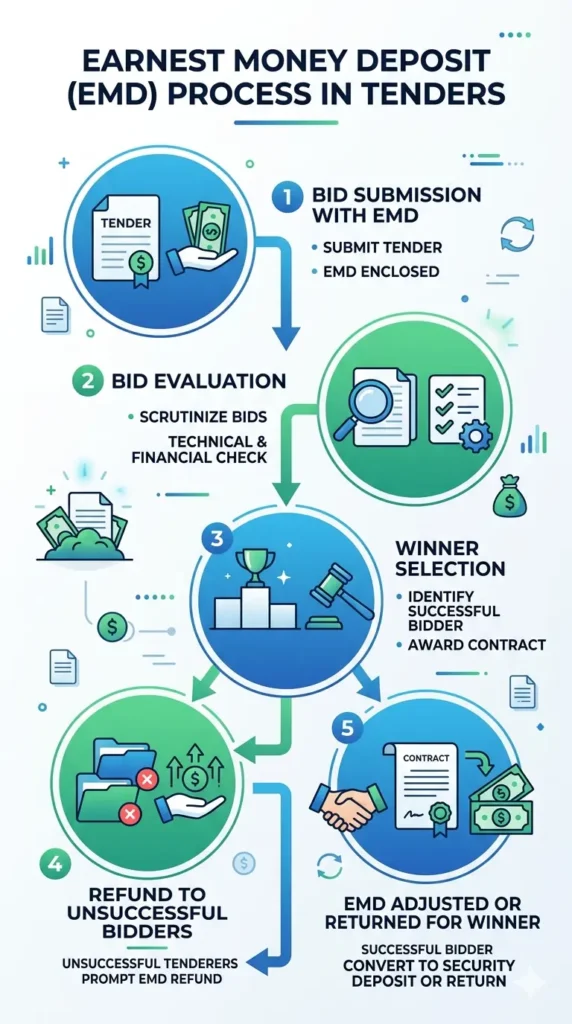
Here is how the typical EMD process works in a tender:
- The tender document specifies the EMD amount, usually between 1% and 5% of the estimated project value.
- Bidders submit their EMD along with their technical bid, typically through a demand draft, bank guarantee, or online payment on portals like GeM or CPPP.
- After bids are opened and a winner is selected, all unsuccessful bidders receive their EMD back.
- The winning bidder’s EMD is either returned after they sign the contract or adjusted against the security deposit.
If a selected bidder withdraws or fails to fulfil the contract terms, the EMD is forfeited and retained by the tendering authority.
How to Handle EMD on the GeM Portal (Step-by-Step)
If you are bidding through the Government e-Marketplace, the EMD process is fully digital. You don’t always need to run to the bank for a physical Demand Draft anymore.
- Check the Bid Document: Open the specific bid on the GeM portal and look for the “EMD” section. It will show the exact amount and the “Advisory Bank.”
- Online Payment: GeM allows you to pay via Net Banking or RTGS/NEFT. Once paid, you must upload the transaction receipt or the “System Generated Challan” in the technical bid section.
- e-BG (Electronic Bank Guarantee): For larger amounts, you can use an e-BG. This is faster because the bank sends a digital notification directly to GeM, so there is no manual verification delay.
- Exemption Claim: If you are an MSME, don’t just skip the payment. You must select “Yes” for EMD exemption and upload your valid Udyam Registration certificate to avoid bid rejection.
What Is the EMD Amount Usually?
The EMD amount is not fixed universally. It depends on the scale, nature, and value of the project. As a general rule:
- For projects valued at Rs. 1 crore, the EMD typically ranges from Rs. 1 lakh to Rs. 5 lakh.
- The tendering authority specifies the exact percentage in the tender notice itself.
- MSMEs (Micro, Small, and Medium Enterprises) and registered startups may be fully exempt from paying EMD under government procurement rules.
Always refer to the specific tender document for the exact EMD requirement before submitting your bid.
What Is the Full Form of EMD and FSD?
This is one of the most commonly asked questions in procurement circles.
- EMD full form = Earnest Money Deposit — paid at the bidding stage to prove serious intent.
- FSD full form = Final Security Deposit — paid by the winning bidder after the contract is awarded to guarantee successful completion of the work.
These two deposits serve different purposes at different stages of the tendering process. EMD comes first and is typically refunded or converted once the contract is signed. FSD comes after the award and is held throughout the contract period to protect the buyer if the contractor defaults or fails to meet performance obligations.
In some documents, you may also encounter SD (Security Deposit) or PG (Performance Guarantee), which serve a similar function to FSD.
While both are financial safeguards, here are the key differences between EMD and Security Deposits in the procurement process:
| Feature | EMD (Earnest Money Deposit) | FSD / SD (Performance Security) |
| When to Pay | During the bidding stage (with the bid) | After the contract is awarded |
| Purpose | To prove the bidder is serious | To ensure the work is completed |
| Typical Amount | 1% to 5% of estimated tender value | 3% to 10% of total contract value |
| Who Pays? | Every participating bidder | Only the winning bidder (L1) |
| Refund Timing | After the tender is awarded | After the project/warranty is over |
| Form of Payment | DD, Bank Guarantee, or Online (GeM) | e-PBG, Bank Guarantee, or FDR |
Why EMD Matters for Businesses Participating in Tenders
Understanding EMD is not just an academic exercise. For businesses actively bidding on government or private tenders, it has real financial implications:
- Cash flow planning: Funds tied up as EMD across multiple bids can strain working capital. Plan ahead.
- MSME exemptions: If your business is MSME-registered, check whether the specific tender grants an EMD waiver before paying.
- Payment modes: Most modern tenders accept online EMD payments via government portals, making the process faster and more transparent.
- Forfeiture risk: Never withdraw a bid after submission or refuse to sign the contract after winning. You will lose your EMD and may face blacklisting.
Staying on top of EMD requirements is one of the fundamentals of successful tendering. Whether you are new to the process or a seasoned bidder, getting this right sets a strong foundation for your procurement journey.
EMD Refund Rules: When and How Do You Get Your Money Back?
One of the biggest headaches for contractors is blocked capital. According to General Financial Rules (GFR), the EMD must be returned to unsuccessful bidders within 30 days of the award of the contract.
- For Unsuccessful Bidders: The money is usually credited back to your linked bank account automatically once the “L1” bidder is finalized and the financial evaluation is complete.
- For the Winner (L1): Your EMD is kept until you submit the Performance Security (e-PBG). Once you provide the final security deposit, the EMD is released or adjusted.
- Risk of Forfeiture: You will lose your deposit if you withdraw your bid before the validity period ends or if you win the bid but refuse to sign the contract.
Frequently Asked Questions About EMD
What is EMD in payment?
EMD is a good-faith deposit paid by a buyer or bidder before a deal is finalised. It proves serious intent and is held until the transaction is complete or a contract is awarded.
Is EMD refunded?
Yes. Unsuccessful bidders get their full EMD back once the tender is awarded. The winning bidder’s EMD is either returned after signing the contract or adjusted against the security deposit.
What does EMD mean in banking?
In banking, EMD is submitted via a Demand Draft, Bank Guarantee, Fixed Deposit Receipt, or online transfer. Banks can issue a guarantee on a bidder’s behalf, so the bidder does not need to block cash directly.
What is the full form of EMD and FSD?
EMD = Earnest Money Deposit (paid at the bidding stage by all bidders). FSD = Final Security Deposit (paid only by the winning bidder after the contract is awarded). Both protect the tendering authority, but at different stages of the process.
Does EMD get refunded?
Yes, in most cases. It is forfeited only if the selected bidder withdraws, refuses to sign the contract, or violates tender conditions. Otherwise, it is fully refunded.
Is EMD returnable?
Yes. EMD is returnable as long as you follow all tender rules. It is not a fee; it is a refundable deposit that comes back to you once the process concludes.
Conclusion
The EMD full form, Earnest Money Deposit, might seem like a small formality, but it is a cornerstone of transparent and accountable procurement. It protects buyers, filters out non-serious bidders, and keeps the bidding process fair for everyone involved.
Whether you are dealing with a government tender, a real estate transaction, or any large procurement process, understanding how EMD works, when it is refunded, and how it differs from FSD gives you a clear advantage.