

Experience criteria in GeM bids refers to the pre-qualification condition that asks a seller to prove past work in a similar category, usually backed by a minimum contract value and limited to a defined look-back period of three to five years, before the buyer even opens the price bid. This single clause decides whether a technically capable seller gets evaluated on price at all, which is why so many sellers lose a tender not on cost but at this earlier eligibility stage. Buyers ask for experience because price alone does not tell them whether a seller can actually deliver at the required scale, so GeM bid eligibility is built to filter for proven capability first. This post breaks down what the experience clause typically demands and how sellers can read it correctly before deciding whether to bid.
What Buyers Are Actually Trying to Verify
Every GeM tender eligibility clause exists because a buyer department is trying to answer one practical question, has this seller actually done something close to this before. A low price from a seller who has never handled an order of this size or category is a real risk for a government buyer, since a failed delivery creates far more administrative trouble than a slightly higher price would have.
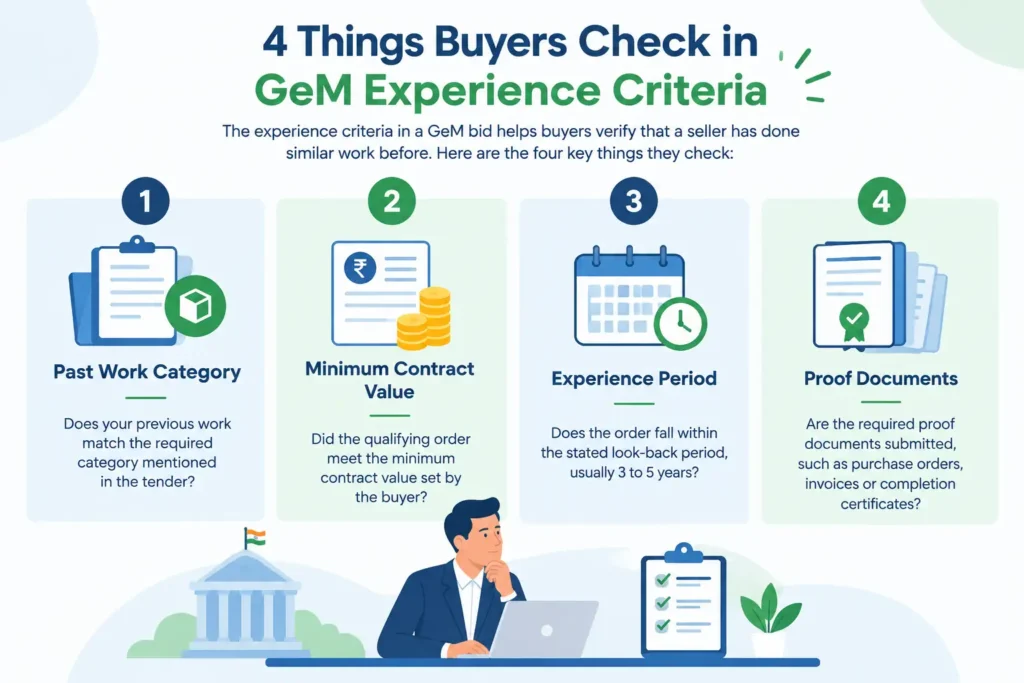
The experience criteria section usually spells out four specific elements. It names the category of past work that counts, sets a minimum contract value each qualifying order must have met, defines how far back in time those orders can be, usually three or five years, and specifies what proof format is acceptable, such as purchase orders, invoices, or completion certificates from the buyer.
Experience Criteria Is Not the Same as Turnover Criteria
Sellers often read these two clauses together and assume they are asking for the same thing, which leads to real confusion. Turnover criteria looks at your total business revenue over past years, verified through audited financials or tax filings. Experience criteria looks specifically at whether you have delivered similar work before, verified through purchase orders and completion proof, not your overall revenue size.
A seller can comfortably meet the turnover requirement while still falling short on experience, particularly if their revenue comes from a different product category than the one being tendered. Reading each clause separately in the tender document, rather than assuming one implies the other, prevents a seller from bidding on something they were never actually eligible for in the first place.
Why This Clause Hits Newer MSMEs the Hardest
A business that has only recently gotten its GeM registration completed naturally has fewer years of documented past work to point to, which is exactly what makes experience criteria the toughest barrier for newer sellers rather than price competition itself. Three patterns show up repeatedly here. A younger business simply has fewer qualifying years behind it. Past orders a business did complete are often spread across several smaller buyers, each falling individually below the minimum contract value threshold even though the combined work was substantial. And a business that recently expanded into a new product line often has no past orders in that exact category, since buyers usually enforce category matching strictly rather than accepting adjacent experience.
How MSE Status Changes the Threshold
Udyam-registered Micro and Small Enterprises often get a relaxed version of this clause, where the required order value or count is lower than what a non-MSE seller must show. This relaxation does not apply automatically everywhere though, it depends on whether the specific tender’s eligibility section explicitly extends it, and on whether the seller’s MSE classification is correctly reflected on their GeM profile. This works alongside the broader MSE purchase preference sellers can access on GeM, since both mechanisms are built around giving smaller businesses a genuine path to compete rather than being locked out purely by scale.
Reading the Clause Before You Decide to Bid
A practical way to approach this is to treat the experience clause as a go or skip filter before investing time in bid preparation. Open the pre-qualification section first and note the exact category, value threshold, and look-back window stated. Then map your own past orders against it honestly, checking that each one falls within the required category and time window, not just that it technically happened in the recent past. If a genuine match exists, gather the proof documents the clause specifically asks for, since purchase orders alone often are not enough if a completion certificate or payment proof is also required. Only once this match is confirmed does it make sense to move into pricing and the rest of the bid submission process, since different bid formats can carry slightly different evaluation weight for technical eligibility before price is even considered.
Where the Clause Quietly Disqualifies Strong Bidders
A seller can be entirely capable of fulfilling an order and still lose at the pre-qualification stage, often for reasons that have nothing to do with actual delivery capacity. Counting past work from an adjacent category rather than the exact one specified is one frequent cause, since buyers rarely accept similar work as a substitute for category-exact experience. Submitting only a purchase order when the clause also asks for a completion certificate is another, since an unfinished or undocumented contract does not prove the work was actually delivered. Orders that fall just outside the stated look-back window get excluded entirely regardless of their value, and assuming an MSE relaxation applies without checking whether that specific tender extends it can lead to a seller bidding on something they were never actually eligible for.
Getting comfortable reading pre-qualification clauses accurately is exactly the kind of skill structured GeM portal training is built to develop, since the ability to quickly judge whether a tender’s experience requirement is realistically reachable saves far more time than preparing a full bid only to be rejected before the price is even opened.
Conclusion
The experience criteria in GeM bids exists to protect buyers from sellers who look competitive on price but have never actually handled similar work at the required scale. Sellers who read this clause carefully before committing time to a bid, rather than assuming eligibility, consistently make better decisions about which tenders are genuinely worth pursuing. For newer MSMEs especially, knowing exactly how MSE relaxations apply and keeping clean, category-matched proof documents ready in advance turns this clause from a barrier into something manageable.
Frequently Asked Questions
1. What counts as valid proof for meeting experience criteria in GeM tenders?
Most tenders accept a combination of the past purchase order, the invoice raised against it, and a completion certificate from the buyer. Some also require payment proof, so the exact accepted format should always be confirmed in the specific tender document.
2. Can experience from private sector clients count toward GeM tender experience requirements?
It depends entirely on the specific tender’s clause. Some tenders accept only government sector past orders, while others accept private sector work as long as the proof format matches what is requested.
3. Does meeting the turnover requirement automatically mean I meet the experience requirement too?
No, these are separate conditions. Turnover reflects overall business revenue, while experience reflects documented past work in a similar category, and a seller can meet one without meeting the other.
4. How can a new MSME with limited past orders still participate in GeM tenders?
Newer MSMEs can focus on tenders where MSE relaxations are explicitly offered, or look for tenders with lower experience thresholds that match their current scale, rather than bidding on contracts requiring years of unmatched history.
5. What happens if a bid fails to meet the experience criteria?
The bid is typically rejected at the technical evaluation stage, which means the price bid is never even opened for review, regardless of how competitive that price might have been.
6. Is the look-back window the same across every GeM tender?
No, it varies by tender, though three to five years is common. Sellers should always confirm the exact window stated in that specific tender’s pre-qualification clause rather than assuming a standard duration.
7. Can a consortium or joint venture help meet experience criteria?
In tenders that explicitly allow consortium or joint venture participation, a partner’s past experience can sometimes help meet the overall requirement, though this depends entirely on whether the specific tender permits this structure.