

GeM portal training is not the same for every seller because manufacturers and traders are evaluated against different documentation, different assessment checkpoints, and different category rules on the portal. A manufacturer needs training focused on OEM authorization, factory proof, and product specification mapping, while a trader needs training focused on authorization letters from the actual manufacturer, resale documentation, and category eligibility as a reseller. Treating both seller types with the same generic training content is one of the biggest reasons MSMEs face repeated rejections during registration and vendor assessment. This post breaks down exactly what changes for each seller type and how to prepare accordingly.
Why Manufacturers and Traders Cannot Follow the Same Training Path
When we work with sellers preparing for GeM Portal Registration, the first question we ask is always the same: are you manufacturing the product yourself, or are you sourcing it from someone else and reselling it. That single answer changes almost every subsequent step, including which documents get uploaded, how the vendor assessment agency evaluates the profile, and which product categories are even open to you.
A manufacturer’s entire credibility on GeM rests on proving that the product originates from their own unit. A trader’s credibility rests on proving a legitimate, traceable relationship with the actual manufacturer whose product they are listing. If your GeM portal training does not separate these two paths clearly from day one, you end up preparing the wrong set of documents and discover the gap only when an assessment query comes back.
What Manufacturers Need to Focus on During Training
1. OEM proof and factory documentation Manufacturers need to be trained on exactly which factory documents carry weight during assessment, such as udyam registration reflecting manufacturing activity, factory license where applicable, and machinery or production capacity proof for certain categories.
2. Product specification accuracy Since manufacturers list their own products, training should cover how to map technical specifications correctly to GeM’s category fields. A mismatch here often leads to catalog rejection even when the business documents are perfectly in order.
3. Deemed OEM status where relevant Some manufacturers operate as contract manufacturers or under a licensing arrangement rather than owning the full production chain themselves. This concept, known as deemed OEM, has its own documentation requirements and directly affects how a manufacturer’s assessment is processed.
4. Brand and quality certifications Depending on the category, manufacturers may need BIS certification, ISO documentation, or other quality marks. Training should map exactly which certification applies to which category rather than treating this as an optional add-on.
What Traders Need to Focus on During Training
1. Authorization letter from the manufacturer A trader’s single most important document is a valid, correctly worded authorization letter from the manufacturer whose products they intend to sell. Training for traders should spend significant time on how this letter should be drafted, what it must contain, and common wording mistakes that get flagged during assessment.
2. Traceability of the supply chain Traders need to show a clean paper trail from manufacturer to their business, including purchase invoices and GST-compliant billing. Vendor assessment agencies often scrutinize this more closely for traders than for manufacturers, since the trader is not the original source of the product.
3. Category restrictions specific to resellers Certain categories on GeM are restricted to manufacturers only, or require additional conditions for resellers to participate. A trader going through generic training without this distinction often finds out too late that an entire category is closed to them.
4. Multiple brand management Traders frequently deal with more than one manufacturer or brand. Training needs to cover how to manage multiple authorization letters and keep each product listing correctly linked to its respective manufacturer’s documentation.
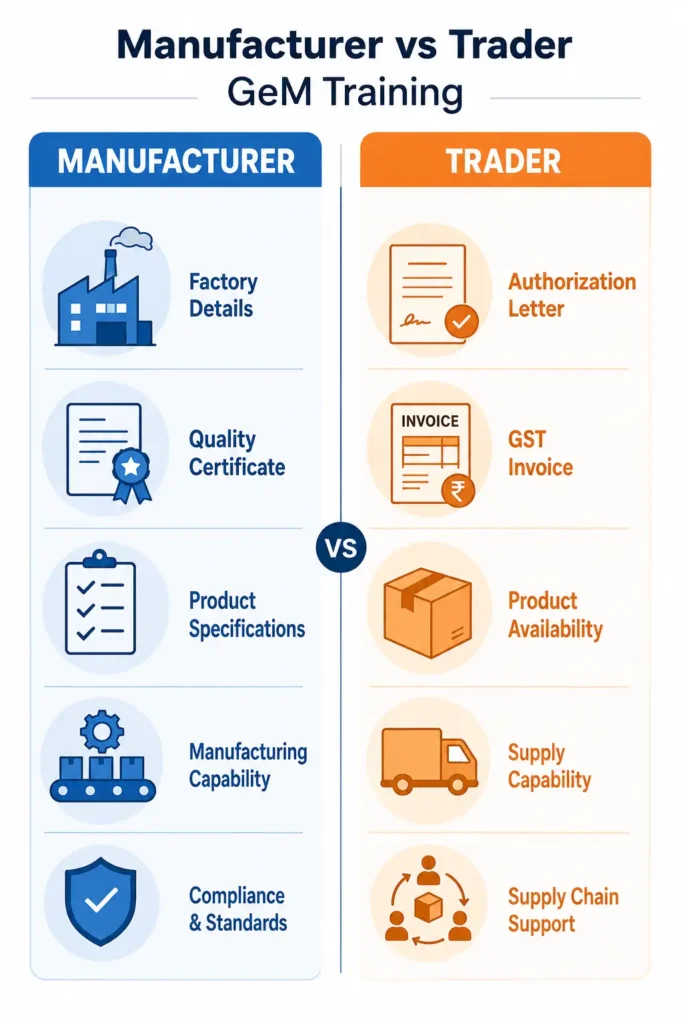
Manufacturer vs Trader Training Focus at a Glance
| Focus Area | Manufacturer | Trader |
|---|---|---|
| Core proof required | Factory and production proof | Manufacturer authorization letter |
| Assessment scrutiny | Product specification and quality certification | Supply chain traceability |
| Category access | Broader, including manufacturer-only categories | Restricted in certain categories |
| Common rejection reason | Specification mismatch | Weak or incorrectly worded authorization letter |
| Documentation complexity | Higher upfront, one-time setup | Ongoing, grows with each new brand added |
Common Mistake We See With Both Seller Types
A pattern we notice repeatedly is sellers attending a single generic training session and assuming it covers their situation, only to realize during vendor assessment that half the guidance did not apply to them. A manufacturer sitting through trader-focused content on authorization letters wastes preparation time, and a trader sitting through manufacturer-focused content on factory proof ends up unprepared for the actual document their assessment will demand. If you already went through the assessment process and want to understand what gets verified after training, our breakdown of what vendor assessment checks in practice is a useful next step before you apply.
Readiness Checklist by Seller Type
For manufacturers:
- Udyam certificate reflects manufacturing activity correctly
- Factory or unit proof is ready, including photographs if the category requires it
- Product specifications match GeM’s category fields exactly
- Relevant quality certifications like BIS or ISO are current and valid
- Deemed OEM documentation is ready if applicable to your business model
For traders:
- Authorization letter is correctly worded and signed by the manufacturer
- Purchase invoices and GST records establish a clear supply chain
- Each product listing is linked to the correct manufacturer’s authorization
- Category eligibility has been verified before listing begins
- Multiple brand documentation is organized separately, not mixed together
Conclusion
Manufacturers and traders are solving two different problems when they prepare for GeM, and training built around one path rarely serves the other well. A manufacturer’s preparation centers on proving origin and production capability, while a trader’s preparation centers on proving a legitimate and traceable relationship with the manufacturer. Once you know which category you fall into, focus your training and documentation entirely around that path instead of trying to prepare for both at once. This alone removes a large share of the confusion that leads to repeated queries and delays during registration and assessment on GeM.
Frequently Asked Questions
1. Can one business register on GeM as both a manufacturer and a trader?
Yes, but each role requires its own set of documentation for the respective products, and the two should not be mixed within a single listing or category application.
2. Is factory verification always required for manufacturers on GeM?
It depends on the product category. Some categories require physical or virtual verification of the manufacturing unit, while others rely primarily on documentation.
3. What happens if a trader’s authorization letter is worded incorrectly?
An incorrectly worded authorization letter is one of the most common reasons for assessment queries or rejection, since it fails to clearly establish the trader’s right to sell that manufacturer’s product.
4. Do traders need a separate authorization letter for every product they list?
Traders generally need authorization tied to each manufacturer they source from, and this should cover all products from that manufacturer rather than requiring a new letter for every single item.
5. Are there categories on GeM that traders cannot access at all?
Yes, certain categories are restricted to manufacturers or require additional conditions that make it difficult or impossible for traders to participate without a direct manufacturing relationship.
6. Does deemed OEM status apply to all manufacturers?
No, deemed OEM status applies specifically to manufacturers operating under contract manufacturing or licensing arrangements rather than owning the entire production process independently.
7. How can a seller find out which category, manufacturer or trader, applies to their business?
This depends on whether the business owns and controls the production of the product or sources it from another manufacturer for resale. Reviewing your actual supply chain and production involvement, rather than how you describe your business informally, is the most reliable way to determine this.