
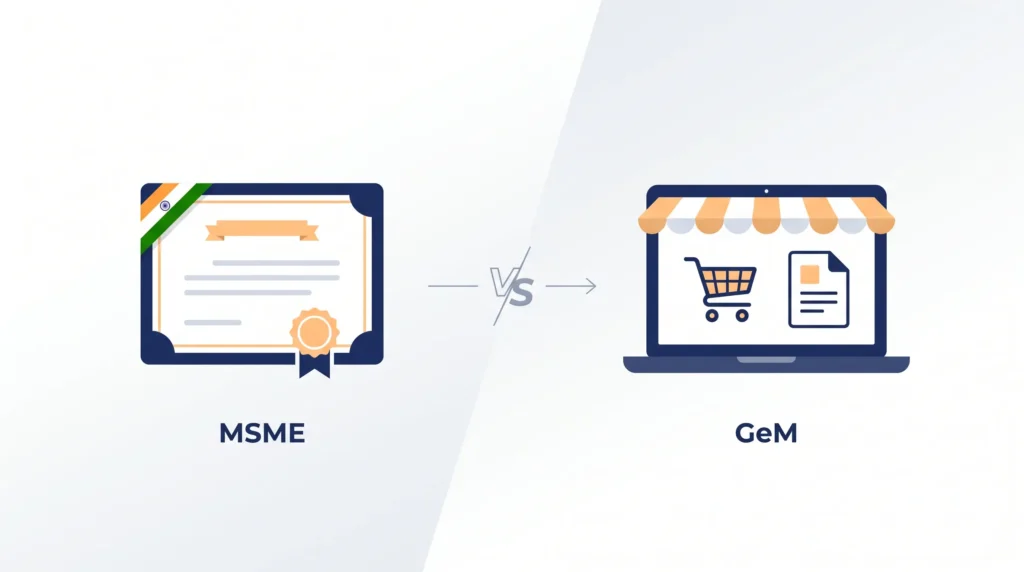
If you run a small business in India, you have probably heard both terms thrown around in the same breath: Udyam Registration and GeM Registration. A lot of business owners assume they are the same thing, or that doing one automatically covers the other. That mix-up costs people time, and sometimes it costs them government tenders they were eligible for.
Let’s clear this up properly. Both registrations matter, but they serve completely different purposes, and understanding the difference will save you a lot of confusion when you are setting up or scaling your business.
What is GeM Registration?
GeM, or Government e-Marketplace, is a completely different system. It is an online platform where government departments, ministries, PSUs, and other government bodies purchase goods and services. If you want to sell products or offer services to the government, you need to be a registered seller on GeM.
GeM Registration is about market access. It lets you list your products or services on a portal where buyers are government entities, not individual customers. Once registered, you can list your catalog, respond to bid requirements, participate in reverse auctions, and receive direct purchase orders from government buyers across India.
Unlike Udyam, GeM Registration involves a more detailed process. You need PAN details, business registration documents, bank account verification, and in many cases an OEM authorization or vendor assessment depending on what you plan to sell. If you are unfamiliar with the process, going through a step by step guide on how to register on GeM portal can save you from common errors that delay approval.
What is Udyam Registration?
Udyam Registration is the official recognition given by the Ministry of Micro, Small and Medium Enterprises (MSME) to classify your business as a micro, small, or medium enterprise. It replaced the older Udyog Aadhaar system a few years ago and is now done entirely online through the Udyam portal.
When you register under Udyam, your business gets a unique Udyam Registration Number and certificate. This is based on your investment in plant, machinery or equipment, along with your annual turnover. Depending on these numbers, your business falls into one of three categories: micro, small, or medium.
Udyam Registration is essentially your business’s identity card as an MSME. It opens the door to a range of government schemes, collateral-free loans, subsidies on patent registration, protection against delayed payments, and various tax benefits. It is free to register and does not require any heavy documentation, just your Aadhaar, PAN, and basic business details.
The Core Difference
Here is the simplest way to think about it. Udyam Registration tells the government what kind of business you are. GeM Registration tells the government where they can buy from you.
One is a classification. The other is a marketplace.
You do not need to choose between them. In fact, most serious sellers end up needing both, but for different reasons:
- Udyam Registration gives you recognition as an MSME and unlocks benefits like priority lending, reduced fees, and protection under the MSME Development Act.
- GeM Registration gives you the actual platform to sell to government buyers and compete for tenders worth lakhs or crores depending on your category.
Another point of confusion is around cost. Udyam Registration has no government fee at all. GeM Registration, on the other hand, may involve charges depending on your seller category and turnover bracket. If you want exact numbers before you start the process, it is worth checking a breakdown of GeM registration fees so you know what to budget for.
Do You Need Both?
If your goal is purely to access MSME schemes, loans, or subsidies, Udyam Registration alone is enough. You do not need to touch GeM at all.
But if your goal is to win government contracts, supply orders, or tenders, Udyam Registration alone will not get you there. GeM is the actual selling platform. You will need to register separately on GeM, and having your Udyam certificate ready actually helps speed up parts of the GeM registration process since MSME sellers get certain category advantages and fee waivers on the portal.
So in practice, most growing businesses end up doing both. Udyam first, since it is quick and free, and then GeM once they decide they want to tap into government procurement as a revenue stream.
A Common Mistake to Avoid
A lot of MSMEs assume that once they have their Udyam certificate, they are automatically eligible to sell on GeM, or that the two portals share data. They do not. You will still need to create a separate account on GeM, upload your documents again, and go through GeM’s own verification steps. Skipping this assumption and treating both as separate journeys will save you a lot of back and forth.
It also helps to understand why registration on either platform matters in the first place, especially if you are still deciding whether this is worth the effort for your business size. A quick read on why GeM registration is essential for your business lays out the practical reasons beyond just ticking a compliance box.
Conclusion
Udyam and GeM are not competing systems, they work alongside each other. Udyam establishes your business identity as an MSME and unlocks support schemes. GeM gives you the marketplace to actually generate business from government buyers.
If you are just starting out, get your Udyam Registration done first since it costs nothing and takes very little time. Once that is sorted, look into GeM Registration as your next step if government tenders and supply contracts are part of your growth plan. Doing both the right way, with the right documents in place, puts your business in a much stronger position to grow without unnecessary delays or rejections.
If you are unsure where to start or keep running into errors during the process, getting guidance from someone who has handled these registrations before is usually faster than figuring it out alone through trial and error.